

Be still and know that I am God
Introduction
We are holding onto the promise of Isaiah 32:18 — that God’s people shall dwell in a peaceable habitation, a sure dwelling place — and we are choosing to treat that not as a distant hope but as a present reality we are standing on. There is something deeply settling about having legal documentation for a property; it means no one can simply take it from you. That is the kind of security God offers us in Him, and we are learning to rest in it rather than constantly striving to earn it.
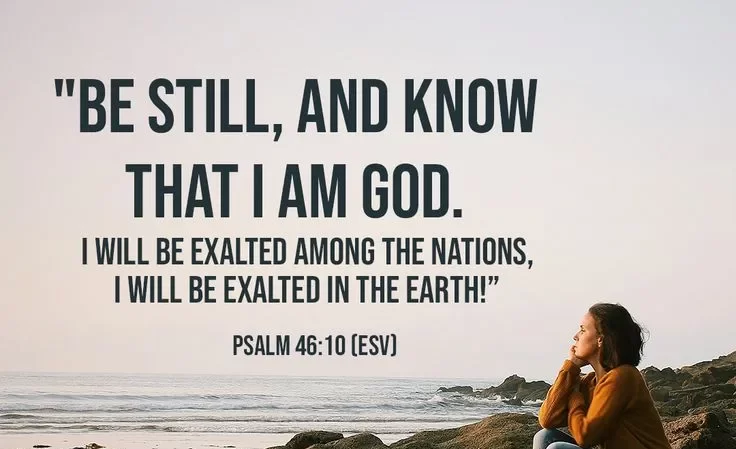
We are also anchored in the promise of empowerment from the Father, referenced in Acts 1:8 — that we shall receive power when the Holy Spirit comes upon us, making us witnesses and, in the truest sense, unstoppable. We do not need to be intimidated by the challenges we face, because the power that resides within us is greater than any external force arrayed against us, as 1 John 4:4 so plainly declares. And when the doors seem closed, when prayer feels quiet, when God appears silent — we are being reminded by Psalm 46:10 to be still and know that He is God. That stillness is not passivity; it is trust, and trust in those moments is one of the most active things we can do.
We are also learning to read our seasons more carefully. Ecclesiastes 3:1 tells us that to everything there is a season, and we are recognising that not every closed door is a permanent wall — sometimes it is simply the wrong season, and wisdom means adapting rather than forcing. A farmer does not plant in every month of the year; they work with the seasons, and the harvest comes to those who understand the rhythm.
We believe God is doing a new thing in our midst, just as He promised in Isaiah 43:19 — making a way in the wilderness, bringing rivers into the desert — and we are positioning ourselves to recognise and step into those new opportunities when they come, whether in employment, relationships, or areas of ministry we have not yet explored. Faith, as Hebrews 11:1 defines it, is the substance of things hoped for and the evidence of things not seen, and we are choosing to diligently seek God rather than be driven by what is merely visible. The examples of farming to feed communities and educate children remind us that faith is practical — it looks like planting seeds in the ground and trusting God for the rain.
Takeaways
We walk away with a quieter and more settled confidence in God’s provision and protection. We are secure in Him — not because our circumstances are all resolved, but because our dwelling place is sure, and nothing that comes against us can alter the covenant we stand under. When doors close and prayers seem to go unanswered, we are choosing to reframe those moments — not as failures or evidence of abandonment, but as seasons of divine redirection, refinement, and preparation.
Romans 8:28 reminds us that all things work together for good for those who love God and are called according to His purpose, and we are holding that promise over the parts of our lives that currently feel unresolved. Challenges are not the end of the story; they are often the very context in which God does His most careful work in us.
We also leave with a renewed intentionality about faith and about being a blessing. Diligently seeking God, as Hebrews 11:6 instructs, is not a passive exercise — it is a deliberate, consistent pursuit that positions us to experience His power and recognise the new things He is creating around us.
We want to be people who are awake to opportunity, alive to what God is doing in each season, and generous enough to look beyond our own needs to the needs of those around us. Being a blessing is not a bonus feature of the Christian life — it is central to it, and we carry that away as a daily commission. God is making a way, and we intend to walk in it with eyes wide open.